
The Neurological Underpinnings of Repetition
In the fast-paced, precision-demanding world of table tennis, the concept of “muscle memory” is more than just a convenient phrase; it’s the very foundation upon which mastery is built. While the term itself is a slight misnomer – muscles don’t actually remember anything – it eloquently describes the phenomenon of highly optimized, almost automatic, motor skill execution. What we colloquially refer to as muscle memory is, in fact, a complex interplay of neural pathways being forged and strengthened within the brain and nervous system. Every forehand loop, every backhand block, every subtle serve receive is not just a physical act but a neurological dance, orchestrated by billions of neurons.
The brain’s incredible capacity for neuroplasticity is at the heart of this process. Neuroplasticity refers to the brain’s ability to reorganize itself by forming new neural connections throughout life. When a table tennis player repeatedly practices a specific shot, their brain is literally rewiring itself. Initially, executing a new stroke requires significant conscious effort. The player must think about grip, bat angle, body rotation, footwork, and follow-through. This conscious processing largely involves the prefrontal cortex, the area of the brain responsible for planning, decision-making, and working memory. However, with consistent and deliberate practice, the locus of control shifts.
The Role of Basal Ganglia and Cerebellum
As a movement becomes more ingrained, the responsibility for its execution gradually migrates from the prefrontal cortex to deeper brain structures, primarily the basal ganglia and the cerebellum. The basal ganglia are crucial for initiating and regulating voluntary movements, learning new motor skills, and forming habits. They act as a kind of “switchboard,” helping to select and execute appropriate movements while suppressing unwanted ones. When a player executes a perfect backhand flick without conscious thought, it’s the basal ganglia working their magic, recalling the precise sequence of muscle contractions and relaxations needed.
The cerebellum, often dubbed the “little brain,” plays an equally vital role. It is a master coordinator, responsible for balance, posture, coordination, and precise timing of movements. In table tennis, the cerebellum constantly monitors sensory input – visual information about the ball’s trajectory, proprioceptive feedback from muscles and joints about body position – and uses this information to refine and correct movements in real-time. This allows for the smooth, fluid, and highly accurate strokes that characterize a skilled player. For instance, adjusting the bat angle by mere degrees to counter an opponent’s spin requires intricate cerebellar processing.
Myelination and Neural Efficiency
Beyond the relocation of processing centers, repeated practice also leads to physical changes in the neural pathways themselves. One crucial change is myelination. Myelin is a fatty substance that insulates nerve fibers, much like the plastic coating on an electrical wire. Myelination increases the speed and efficiency of electrical signal transmission along these pathways. The more a particular movement pattern is practiced, the more myelinated the relevant neural circuits become. This translates directly into faster reaction times, smoother movements, and less mental effort required to execute complex shots. It’s why an experienced player can respond to a lightning-fast smash with seemingly effortless grace, while a beginner struggles to even make contact. The signals in the experienced player’s brain are traveling at warp speed along highly myelinated “information highways.”
In exploring the concept of muscle memory in table tennis, it’s interesting to consider how repetitive practice not only enhances physical skills but also influences cognitive processes. A related article that delves into the importance of mental training and the value of embracing monotony in skill development is “Why Memory Champions Value Boredom.” This piece highlights how champions in memory sports utilize repetitive techniques to strengthen their mental capabilities, paralleling the way athletes refine their physical abilities through drills. For more insights, you can read the article here: Why Memory Champions Value Boredom.
The Science of Deliberate Practice and Drills
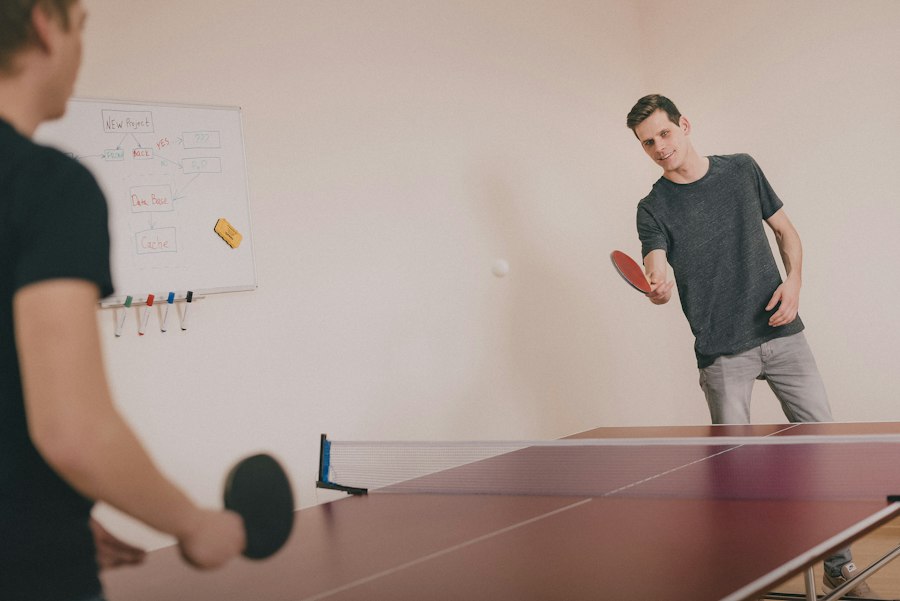
In table tennis, the pathway to developing robust “muscle memory” is paved with deliberate practice and structured drills. It’s not enough to simply hit balls; the practice must be purposeful, focused, and designed to challenge the player just beyond their current capabilities. This concept, often associated with researcher K. Anders Ericsson, emphasizes that true expertise comes from engaging in activities that are specifically designed to improve performance, often involving immediate feedback and correction.
Designing Effective Drills
Effective table tennis drills are not random; they are meticulously crafted to isolate specific skills and repeatedly engrave them into the player’s neural architecture. A coach might design a drill to focus solely on forehand topspin consistency from the backhand corner, or perhaps a complex footwork pattern involving a forehand counter-loop followed by a backhand block. The key is repetition with intent.
When designing drills, several factors come into play:
- Specificity: Drills should target specific strokes, footwork patterns, or tactical situations. For example, a drill for serve receive might involve the coach serving various spins and speeds, requiring the player to adapt their return.
- Repetition with Variation: While repetition is vital, endless, identical repetition can lead to stagnation. Introducing slight variations in ball placement, spin, or speed forces the brain to adapt and refine the motor program, making it more robust and versatile. For instance, a drill focusing on forehand loops might vary the depth of the incoming ball, forcing slight adjustments in footwork and body angle.
- Progressive Difficulty: Drills should gradually increase in complexity and intensity as the player improves. What starts as a simple forehand-backhand alternating drill can evolve into a multi-ball drill requiring rapid transitions and tactical thinking.
- Immediate Feedback: Timely and accurate feedback is crucial for motor learning. A coach can provide verbal cues, demonstrate correct technique, or use video analysis to highlight areas for improvement. This feedback helps the brain correct errors and reinforce successful movements.
- Contextual Practice: Eventually, drills should move beyond isolated movements to incorporate more game-like situations. Practicing combinations of shots under pressure, simulating match scenarios, helps integrate individual skills into a cohesive game plan.
The Power of Repetition and Error Correction
The neurological magic of drills lies in the iterative process of repetition and error correction. Each time a player executes a stroke, their brain gathers sensory information: did the ball go where intended? What was the feeling in the arm and wrist? Was the timing correct? If the outcome is not optimal, the brain analyzes the discrepancy and adjusts the motor program for the next attempt. This constant feedback loop, often operating below conscious awareness in experienced players, is how the brain refines the neural pathways.
Consider a beginner trying to learn a forehand loop. Their initial attempts might be inconsistent, with the ball flying off the table or hitting the net. With each attempt, they receive feedback (visual, auditory, kinesthetic) and make small adjustments. Over time, the brain starts to identify the precise muscle activations, joint angles, and timing required to consistently execute a successful loop. The neural circuit for that particular shot becomes stronger, more efficient, and more resistant to interference.
Visualisation and Mental Practice
Beyond physical drills, mental practice and visualization also play a significant role in wiring the brain for table tennis success. Studies have shown that mentally rehearsing a movement can activate similar neural pathways as actually performing the movement, albeit to a lesser extent. A player visualizing a perfect forehand loop, complete with all the sensory details – the feel of the bat, the sound of contact, the trajectory of the ball – helps reinforce the existing neural circuits and can even help create new ones. This is particularly useful for pre-match preparation or when physical practice isn’t possible due to injury or other constraints. It taps into the brain’s ability to simulate experiences, further embedding the motor patterns.
The Development of Automaticity and Flow State
One of the most profound outcomes of dedicated drilling and the development of “muscle memory” is the attainment of automaticity. Automaticity refers to the ability to perform tasks without conscious thought or effort. In table tennis, this manifests as playing in a “flow state,” where actions feel fluid, reactions are instantaneous, and the player is fully immersed in the game without distraction.
From Conscious Competence to Unconscious Competence
The journey to automaticity can be understood through the four stages of competence:
- Unconscious Incompetence: The player doesn’t know what they don’t know. They are unaware of their lack of skill.
- Conscious Incompetence: The player recognizes their lack of skill and consciously tries to improve. This stage is often frustrating, as every action requires deliberate thought.
- Conscious Competence: The player can perform the skill correctly, but it still requires conscious effort and concentration. This is where most players spend a significant amount of time during practice, refining their technique.
- Unconscious Competence: The player can perform the skill effortlessly and automatically, without conscious thought. This is the desired state for elite table tennis players. Their “muscle memory” has taken over, allowing them to focus on strategy and tactics rather than the mechanics of each shot.
When a player reaches unconscious competence for a particular stroke or movement pattern, their prefrontal cortex is freed up. Instead of expending cognitive resources on how to execute a forehand, they can now use that mental bandwidth to anticipate their opponent’s next move, plan their strategy, or read the spin on the ball. This cognitive offloading is a critical advantage in a sport where milliseconds can make the difference between winning and losing.
The “Flow State” Phenomenon
Automaticity is a key prerequisite for entering a “flow state,” a concept popularized by psychologist Mihaly Csikszentmihalyi. Flow is characterized by intense focus, a sense of timelessness, and a feeling of effortless action. In table tennis, players in a flow state report feeling “in the zone,” where the ball seems to slow down, and their movements are perfectly coordinated. This heightened state of performance is directly linked to the brain’s ability to execute complex motor patterns automatically, allowing cognitive resources to be fully dedicated to the present moment and tactical decision-making.
The neurological basis of flow involves a temporary reduction in activity in certain areas of the prefrontal cortex, a phenomenon sometimes called “transient hypofrontality.” This allows for a less inhibited, more intuitive mode of operation. When “muscle memory” is highly developed, the brain doesn’t need to consciously deliberate on each stroke, thus facilitating this state.
The Impact on Reaction Time and Decision Making
With automaticity, reaction times in table tennis dramatically improve. Instead of a multi-step process involving perception, conscious decision, and then action, the highly ingrained neural pathways allow for a near-instantaneous, reflexive response. A player can “read” an opponent’s serve and immediately initiate the correct return stroke without conscious analysis. This is not to say that strategic thinking disappears, but rather that the fundamental execution of skills becomes a background process, freeing the foreground for higher-level cognitive tasks.
Moreover, automaticity reduces cognitive load. When basic skills are automatic, the brain isn’t overloaded with mechanics. This allows for better decision-making under pressure. A player can analyze the game situation, identify weaknesses in their opponent’s play, and choose the most effective shot, all while their body is flawlessly executing the necessary movements. This synergy between automatic physical execution and deliberate tactical thought is the hallmark of a truly great table tennis player.
If you’re looking to improve your memory skills, the techniques used by a Memory Athlete can be incredibly beneficial. Many people have found success in enhancing their cognitive abilities by following the strategies outlined by a Memory Athlete. By exploring the methods of a Memory Athlete, you can unlock new potential in your mental performance.
Overcoming Plateaus and Adapting “Muscle Memory”
While “muscle memory” is a powerful asset, it can also lead to plateaus if not managed correctly. The very strength of ingrained neural pathways can make it challenging to adapt or change a deeply learned technique. Players often hit a wall where their current set of automatic movements, while effective to a point, are no longer sufficient to progress. Overcoming these plateaus and consciously adapting “muscle memory” requires a structured and often uncomfortable process.
The Challenge of Unlearning and Relearning
Changing an established motor program is often harder than learning a new one from scratch. This is because the brain has already created strong, efficient pathways for the old technique. Trying to implement a new technique essentially means fighting against these ingrained patterns. For example, a player who has consistently used a closed bat angle for their forehand might struggle immensely to open it up for a faster loop, even if they understand the benefits intellectually. Their brain and body naturally revert to the old, comfortable pattern.
To overcome this, players must consciously re-enter the “conscious incompetence” or “conscious competence” stages. This involves:
- Awareness: Identifying the specific technical flaw or desired change. This often requires external feedback from a coach or video analysis.
- Deliberate Practice with High Focus: The player must consciously override their old habits. This means focusing intensely on every aspect of the new movement, even if it feels awkward and unnatural. Drills should be designed specifically to isolate and reinforce the new technique, initially at a slower pace.
- Increased Repetition of the New Pattern: The new neural pathways need to be strengthened through consistent repetition, just like the original ones were. This period can be frustrating as performance might temporarily decline.
- Patience and Persistence: It takes time to rewrite “muscle memory.” Players need to understand that improvement won’t be linear and setbacks are part of the process.
The Role of Variability Training
To make “muscle memory” more adaptable and less prone to rigid plateaus, variability training is crucial. Instead of always practicing the same shot in the same way, introducing variations helps the brain develop more flexible and robust motor programs.
Examples of variability training include:
- Random Practice: Interleaving different shots or drills rather than blocking them. For example, alternating between forehand loop, backhand block, and push return in a single drill session. This forces the brain to constantly retrieve and apply different motor programs, making them more versatile.
- Contextual Interference: Practicing skills in varied environments or under different conditions. This might involve playing with different opponents, on different tables, or even in different lighting conditions.
- Constraint-Led Approach: Introducing specific constraints that force the player to adapt their movements. For example, restricting footwork to encourage more arm involvement, or requiring a specific spin on a return shot.
This kind of training helps build a more generalized motor program rather than a highly specific, rigid one. It teaches the brain to adapt and problem-solve on the fly, making the player less predictable and more resilient to varying game situations.
Recovery and Avoiding Overtraining
While repetition is key, the brain and body also need time to consolidate learning. Adequate rest and recovery are essential for the neurological processes involved in memory consolidation. Overtraining can lead to physical fatigue, mental burnout, and even reinforce incorrect techniques if the player is too tired to maintain focus. Quality of practice often trumps sheer quantity.
During sleep, the brain actively works to consolidate memories, including motor skills. This is why a good night’s sleep after an intense practice session is just as important as the session itself for embedding those “muscle memory” patterns. Smart training schedules that balance intensity with rest are paramount for long-term development and adaptation.
In exploring the concept of muscle memory in table tennis, it’s fascinating to consider how repetitive drills not only enhance physical performance but also wire the brain for improved reflexes and decision-making. For those interested in further developing their cognitive skills alongside physical training, a related article offers insights on structuring a mental training regimen. You can read more about this approach in the article on creating a weekly mental training plan, which complements the physical aspects of sports like table tennis.
The Future of “Muscle Memory” Training: Technology and Personalization
| Aspect | Description | Impact on Performance | Example Drill |
|---|---|---|---|
| Repetition | Consistent practice of specific strokes to engrain movement patterns | Improves accuracy and speed of stroke execution | Forehand loop repetition against multiball |
| Neural Adaptation | Brain rewires neural pathways to automate movements | Reduces reaction time and cognitive load during play | Shadow play focusing on footwork and stroke timing |
| Feedback Integration | Using sensory feedback to refine motor skills | Enhances precision and consistency | Coach or video analysis with corrective drills |
| Drill Frequency | Number of practice sessions per week | Higher frequency leads to faster muscle memory development | Daily 30-minute targeted stroke drills |
| Skill Retention | Duration muscle memory lasts without practice | Regular drills needed to maintain skill level | Weekly maintenance drills after intensive training |
As our understanding of neuroscience and motor learning deepens, coupled with rapid advancements in technology, the future of “muscle memory” training in table tennis is poised for significant innovation. Personalized training regimens, data-driven feedback, and even brain-computer interfaces could revolutionize how players master recall, sharpen focus, and unlock their brain’s full potential.
Wearable Technology and Biometric Feedback
Current wearable technologies can track heart rate, movement patterns, and even swing speed. In the near future, these devices will become even more sophisticated, providing real-time biometric feedback during drills. Imagine a sensor on a table tennis paddle that not only measures bat angle and speed but also provides immediate haptic feedback (e.g., a subtle vibration) if the angle is incorrect for a specific spin. Or sensors on the body that analyze joint angles and body rotation, offering instant corrections.
This level of detailed, objective feedback bypasses the often-subjective nature of human coaching (though coaching will always remain vital) and allows for precise, micro-adjustments to technique. It enables players to understand exactly what they are doing right or wrong, accelerating the process of refining motor programs and ingraining correct “muscle memory.”
Virtual Reality (VR) and Augmented Reality (AR) Training
VR and AR offer immersive environments for training that can simulate game conditions with incredible realism. Players could practice against virtual opponents with varying styles, speeds, and spins, all within a controlled digital environment. This allows for:
- High-Volume, Low-Cost Practice: Unlimited repetitions without needing a physical opponent or court time.
- Risk-Free Experimentation: Players can try out new techniques or tactics without fear of losing points in a real match.
- Personalized Scenarios: VR environments can be customized to focus on a player’s specific weaknesses, creating scenarios that repeatedly challenge them in those areas.
AR, overlaying digital information onto the real world, could provide real-time visual cues during practice – perhaps showing the optimal contact point on the ball or the ideal trajectory for a serve return. These visual aids can significantly enhance the learning process by providing immediate, context-specific feedback that directly influences neural pathway formation.
Neurofeedback and Brain-Computer Interfaces (BCIs)
The most futuristic advancements lie in neurofeedback and potentially BCIs. Neurofeedback involves monitoring brain activity (e.g., via EEG) and providing real-time feedback to the individual. In the context of “muscle memory,” this could help players learn to optimize their mental state for peak performance – perhaps by training their brainwaves to enter a “flow-like” state more easily, or to enhance focus during critical moments.
BCIs, while still largely experimental for sports training, hold the promise of directly influencing neural activity. While direct neural implants are a long way off for athletes, non-invasive BCIs could potentially be used to identify and strengthen specific neural circuits associated with desired motor skills, or even to accelerate the consolidation of motor memories during rest periods. This would represent the ultimate personalization of “muscle memory” training, tailoring interventions directly to the brain’s unique wiring.
Ultimately, these technological innovations will not replace the fundamental principles of deliberate practice and the human element of coaching. Instead, they will serve as powerful tools to augment and accelerate the learning process, allowing table tennis players to develop more robust, adaptable, and efficient “muscle memory” than ever before, pushing the boundaries of human performance and unlocking unprecedented levels of skill.
Elevate your memory and cognitive performance today! Download Memory Athlete, the ultimate app for mastering recall, sharpening focus, and unlocking your brain’s full potential. Available now on the App Store and Google Play.




Leave a Reply